← Home · Ground improvement

Vibrocompaction Design for Hawke’s Bay Soils

Together, we solve the challenges of tomorrow.

LEARN MORE →

The NZGS guidelines on ground improvement are the starting point for any vibrocompaction design on the North Island’s east coast, and Napier’s gravelly alluvium demands a precise analytical approach. Much of the city rests on fluvial deposits from the Tutaekuri River, where loose sands and silty gravels extend to depths exceeding 12 metres. The 1931 earthquake raised sections of the seabed by nearly two metres, creating the coastal plain now occupied by Ahuriri and Pandora — ground that was never naturally consolidated under its current overburden. A vibrocompaction scheme here must reconcile the seismic demands of NZS 1170.5 with the variable grain-size distribution encountered across the Heretaunga Plains. Rather than applying generic spacing grids, our design process models the required relative density target against the site-specific fines content, because even a small increase in silt fraction can shift the compaction mechanism from liquefaction-based densification to displacement-dominated behaviour.

Vibrocompaction in Napier is not a standard grid exercise — it is a depth-specific response to post-1931 fluvial deposits where relative density governs seismic performance.
Methodology and scope

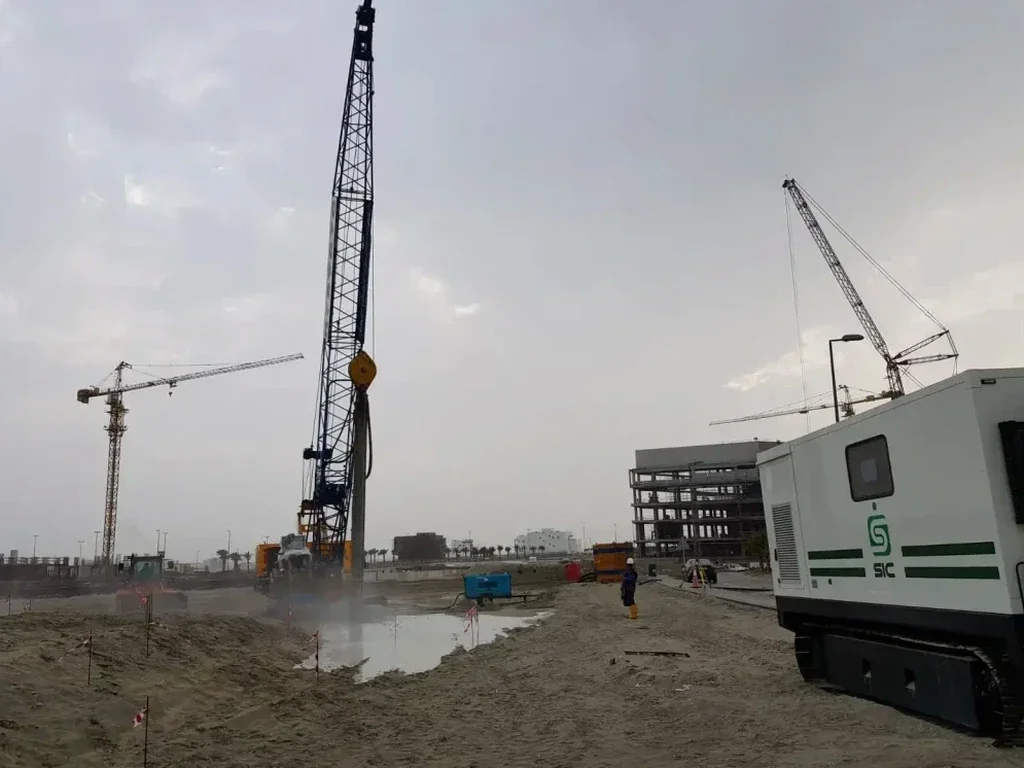
A recent project on a light-industrial site near Taradale Road illustrated this directly. The developer planned a 24-metre clear-span portal frame on shallow footings, with floor slab tolerances tighter than NZS 3604 defaults. Borelogs from our CPT testing programme showed cone resistances of just 3 to 5 MPa between 3 and 8 metres, with a pore pressure response that confirmed contractive behaviour. The vibrocompaction design was tuned to achieve a post-treatment relative density above 70 percent, using a triangular grid of 2.4 metres with a vibrator operating at 1800 rpm. Real-time compaction control logged amperage and penetration rate every 0.1 metre, ensuring energy delivery matched the target profile. Where the upper 1.5 metres showed organic silt, we recommended a combined solution using stone columns as a bridging layer before compaction, avoiding the common mistake of attempting densification in cohesive material.
Vibrocompaction Design for Hawke’s Bay Soils
Technical reference image — Napier

Local considerations

A recurring observation on Napier sites is the misinterpretation of pre-treatment CPT data: a thin crust of desiccated silt, perhaps 1.5 metres thick, can mask loose sand below, leading designers to underestimate settlement. Post-cyclone Gabrielle, many properties between Marewa and Onekawa showed differential movement of 15 to 40 millimetres where this crust bridged across untreated lenses. The technical risk is compounded when vibrocompaction is specified without a trial zone — energy transmission through the gravel stringers common in the Tutaekuri fan can be highly anisotropic. A design that omits depth-specific energy calibration and relies solely on empirical charts will miss the lateral variability that defines the Heretaunga alluvial sequence.

Need a geotechnical assessment?

Reply within 24h.

Email: [email protected]

Technical parameters

ParameterTypical value
Design earthquake magnitude (Mw)7.0–7.5 (per NZS 1170.5)
Target relative density (Dr)≥70% for liquefaction-prone layers
Maximum treatable fines content<15% passing 75 µm
Vibrator power class130–180 kW, variable frequency
Typical treatment depth range4–15 m below ground level
Grid patternTriangular, 1.8–3.0 m spacing
Post-treatment verification methodCPT or SPT with before/after comparison

Associated technical services

01

Pre-treatment CPT and grain-size assessment

We execute a targeted CPT campaign to map loose zones, supported by sieve analysis to confirm fines content below the 15 percent threshold required for effective vibrocompaction in Napier gravelly alluvium.

02

Grid design and energy calibration

Triangular grid spacing is calculated from target relative density and vibrator specifications, with a mandatory trial panel to calibrate amperage, penetration rate, and hold time against the site stratigraphy.

03

Post-compaction verification reporting

After treatment, a second CPT or SPT round quantifies the improvement. The report compares pre- and post-treatment cone resistance profiles and provides a signed PS3 producer statement for building consent.

Applicable standards

NZS 3404:1997 – Steel structures (vibrator mast and rig stability), NZS 1170.5:2004 – Earthquake actions (seismic demand for ground improvement), NZGS Guidelines – Module on ground improvement and liquefaction assessment

Questions and answers

What depth can vibrocompaction treat in Napier soils?

In the Heretaunga Plains, effective treatment depth ranges from 4 to 15 metres, depending on vibrator power and the gravel content of the Tutaekuri fan deposits. Deeper loose lenses below the water table can be reached, but energy attenuation in silty seams must be accounted for during trial compaction.

How does the 1931 uplift affect vibrocompaction design?

The Napier earthquake raised the coastal plain by up to 2 metres, meaning the upper layers of soil in areas like Ahuriri were never subjected to the overburden stress typical of compacted river terraces. This results in lower initial relative densities, so design must target a higher energy input to compensate for the under-consolidated state.

What is the approximate cost range for a vibrocompaction design package in Napier?

A complete design package — including CPT investigation, trial panel analysis, grid specification, and post-treatment verification — typically falls between NZ$2,190 and NZ$7,510, depending on site area, depth of treatment, and the number of verification soundings required for council consent.

Location and service area

We serve projects in Napier and surrounding areas. More info.

View larger map