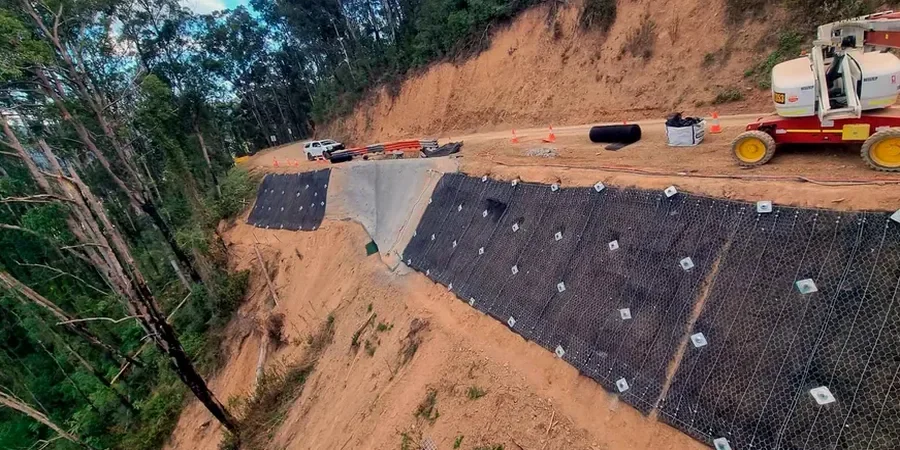
A common mistake on Napier hillside projects is treating slope stability as a secondary check rather than the primary design constraint. The 2017 Napier Hill slip that forced emergency evacuations on Lighthouse Road wasn't caused by unusual rainfall alone — it exposed decades of underestimating how pore-water pressure builds in the layered Miocene sediments that underlie much of the city's elevated suburbs. When contractors skip a proper site-specific analysis and rely on generic regional assumptions, the margin for error shrinks to zero. Our technical team approaches every Napier slope assessment by first mapping the contact between the Scinde Island limestone and the underlying软弱 siltstone, because that interface is where most local failures initiate. For deeper investigations into the weathered profile, combining the slope analysis with test pits lets us sample the critical transition zone directly, rather than inferring its properties from surface mapping alone.
Napier's limestone-siltstone contact is the single most critical geological surface for slope stability in the city — miss it and the analysis is worthless.
Local context
A 14-metre cut on Bluff Hill in 2021 exposed a siltstone layer with a 22-degree dip direction nearly parallel to the excavation face. The contractor had assumed a homogeneous limestone profile based on three boreholes spaced 30 metres apart. Within 48 hours of a 65 mm rainfall event, a wedge failure mobilized 400 cubic metres of material, shutting down the site for eleven weeks. The investigation afterwards showed the boreholes had all terminated just above the critical siltstone contact. This scenario repeats across Napier because the Scinde Island limestone varies from massive to highly fractured over distances of less than 20 metres, and the underlying软弱 siltstone weathers rapidly when exposed. A defensible slope stability analysis in this city requires continuous core logging through the full weathered profile, laboratory testing under saturated conditions, and pore-pressure assumptions that account for the lag between rainfall intensity and groundwater response measured in local piezometers.
Questions and answers
What triggers most slope failures in Napier's hill suburbs?
The primary trigger is prolonged or intense rainfall that saturates the weathered siltstone beneath the Scinde Island limestone. Field monitoring in Hospital Hill and Bluff Hill shows pore-water pressures can rise to critical levels within 24 to 48 hours of rainfall exceeding 50 mm in 24 hours, which is common during ex-tropical cyclones. Secondary triggers include unplanned excavation at the toe and uncontrolled stormwater discharge onto slopes.
What does a slope stability analysis for a Napier residential section typically cost?
For a standard residential lot on Napier's hillside terrain, a complete slope stability assessment including geological mapping, borehole drilling with sampling, laboratory triaxial testing, and limit equilibrium analysis with a formal report for building consent typically ranges from NZ$1,790 to NZ$6,830 depending on slope height, access constraints, and the number of cross-sections required by the District Plan.
How does the Napier City Council consent process handle slope stability?
Under the District Plan's Earthworks and Geotechnical provisions, any building platform on land with a slope exceeding 15 degrees, or any cut or fill exceeding 1.5 metres, triggers a requirement for a geotechnical assessment prepared by a Chartered Professional Engineer (CPEng) with slope stability expertise. The report must demonstrate compliance with NZGS guidelines and NZS 4404, and peer review is commonly requested for sites in the Hospital Hill and Bluff Hill hazard overlay zones.