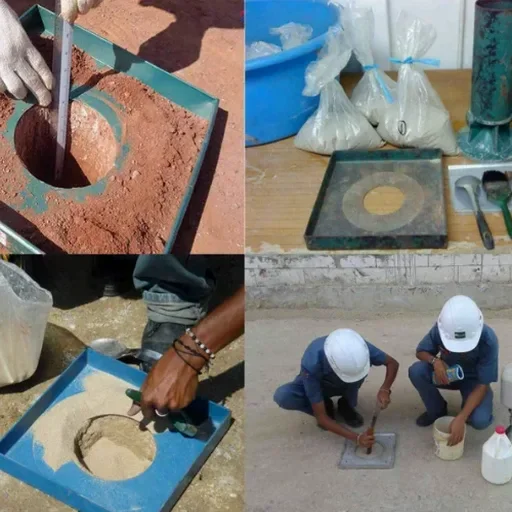
Napier’s coastal terrace geography and the legacy of the 1931 earthquake mean much of the city sits on layered alluvial gravels, silts, and reworked marine sediments. The dry, Mediterranean-like summers on the Heretaunga Plains can strip moisture from exposed fill, while winter cyclones saturate the same material within days. Achieving target compaction in these conditions is not just a specification checkbox—it directly determines whether a foundation slab will perform or crack over time. For subdivision earthworks in areas like Poraiti or Te Awa, the sand cone density method remains the practical field standard for verifying lift-by-lift compaction. When the subsurface profile includes lenses of pumiceous silt, we often pair density data with a triaxial test to confirm that the achieved strength meets the structural design assumptions.
A 95% modified Proctor result from the sand cone test is only meaningful if the fill hasn’t been drying out for three days before the technician arrives—moisture timing makes or breaks the result.
Local context
The Heretaunga Plains gravels and silts can lose up to 2 percent moisture per day under Napier’s nor’wester winds, creating a deceptive crust that passes a density test while underlying material remains under-compacted. This is the classic failure mode in residential subdivisions across the city—service trenches cut through the crust, water infiltrates, and differential settlement appears within the first two years. On commercial sites near the Marine Parade shoreline, saline groundwater accelerates the consolidation of poorly compacted silty layers, leading to pavement deformation in carparks and access roads. A sand cone test conducted at the right depth and within a narrow moisture window is the most reliable defence against these outcomes, because it measures density directly rather than inferring it from a nuclear gauge reading that can be skewed by soil chemistry. Without systematic field density verification, the risk chain runs from a passed visual inspection straight to expensive post-construction remediation.
Questions and answers
How much does a sand cone field density test cost on a Napier subdivision?
For a standard residential lot in the Napier area, individual sand cone tests typically fall in the range of NZ$160 to NZ$220 per test, depending on the number of tests scheduled in a single site visit and the travel distance. Bulk earthworks projects with repeat testing over multiple days generally achieve a lower per-test rate.
How many density tests does Napier City Council require for a s224c subdivision sign-off?
Napier City Council generally follows the NZS 4431 guidance of minimum one field density test per 500 m² per compacted lift, with additional tests required around service trenches and manholes. The exact frequency is confirmed during the pre-application meeting with the council’s development engineering team.
Can the sand cone method be used in gravelly Hawke’s Bay fills?
Yes, with the caveat that the maximum particle size must be less than about 37.5 mm for the standard 150 mm density plate to seat properly. In fills with cobbles or large river gravels common near the Tutaekuri River, we switch to a larger-volume replacement method or use a test pit excavation for direct density measurement.
What moisture content is acceptable for compacting Napier’s silty soils?
Optimum moisture content varies by material, but the critical rule for Hawke’s Bay silts and silty gravels is to compact within 2% of optimum on the wet side. Allowing the fill to dry below optimum before compaction—common during summer nor’wester conditions—produces a friable structure that will collapse on wetting, even if a density test passes.