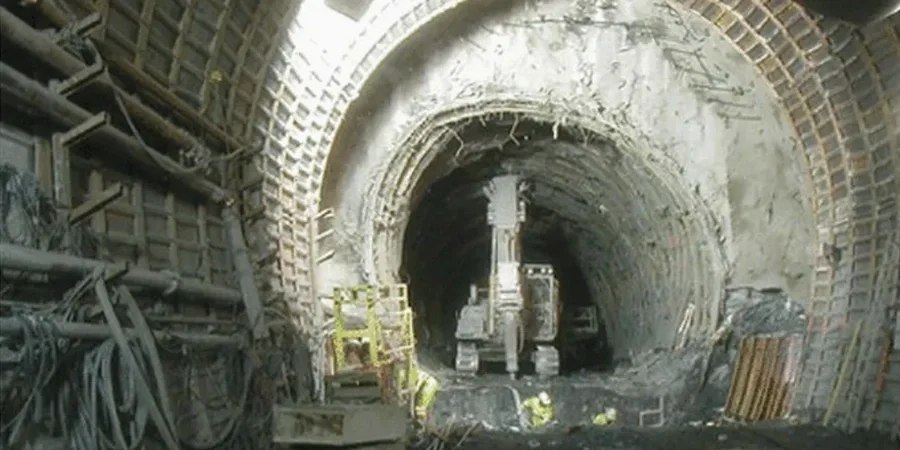
NZS 3404:1997 and the NZGS soil and rock description guidelines drive every soft ground tunnel assessment in Napier. The 1931 Hawke's Bay earthquake raised the coastal plain by over a metre, leaving behind a layered stratigraphy of marine silts and saturated pumice sands that challenges conventional tunnelling. Shallow groundwater and confined aquifers create face instability risks that standard reconnaissance fails to detect. Our geotechnical analysis for soft soil tunnels connects high-quality continuous sampling with laboratory strength testing to define the deformation envelope before the first cut. For deep alignments through compressible layers, we often pair this with CPT testing to capture pore pressure dissipation in real time, and rely on triaxial testing to establish effective stress parameters at working depth.
Napier's post-1931 stratigraphy combines artesian gravels and soft marine silts: a two-metre advance without face calculation can trigger surface collapse in under four hours.
Local context
Napier sits at roughly 2 metres above mean sea level, with large areas below the post-1931 uplift still relying on pump drainage. Any tunnel excavation in this topography introduces a hydraulic gradient toward the face, pulling salt water and fine sediment through untreated pathways. Ingress rates exceeding 5 litres per second have been recorded in shallow pilot bores near Pandora. Beyond flooding, the real danger is internal erosion: the piping of silty matrix from the Scinde Island colluvium that leaves a rigid skeleton of gravel clasts, which then collapses under overburden load. A geotechnical analysis for soft soil tunnels must specify the filter criteria and grouting programme that prevent migration, not just control inflow. The NZGS guideline on groundwater control in urban tunnelling sets the benchmark for acceptance.
Questions and answers
What is the cost range for a geotechnical analysis for a soft soil tunnel in Napier?
The fee for a site-specific soft soil tunnel analysis in Napier typically ranges from NZ$7,400 for a short service tunnel to NZ$30,540 for a comprehensive programme on a longer alignment. The scope includes field investigation, laboratory testing, and face stability reporting.
How does the 1931 earthquake history affect tunnel design in Napier?
The 1931 Hawke's Bay earthquake elevated the coastal plain, creating a layered sequence of marine silts over gravels. This history means the soil is often normally consolidated with artesian groundwater conditions that must be modelled explicitly for any tunnel excavation.
Which laboratory tests are essential for soft ground tunnelling?
The core suite includes undrained triaxial compression tests to define su, oedometer consolidation tests for compressibility, and Atterberg limit determinations. For the Napier silts, particle size distribution by hydrometer is also critical to assess piping potential.
Can you analyse a tunnel that crosses from limestone into soft soil?
Yes. Mixed-face tunnelling at the Scinde Island limestone boundary is a specific focus. The analysis defines the transition zone, the required face reinforcement, and the excavation sequence to manage the abrupt change in strength and stiffness.