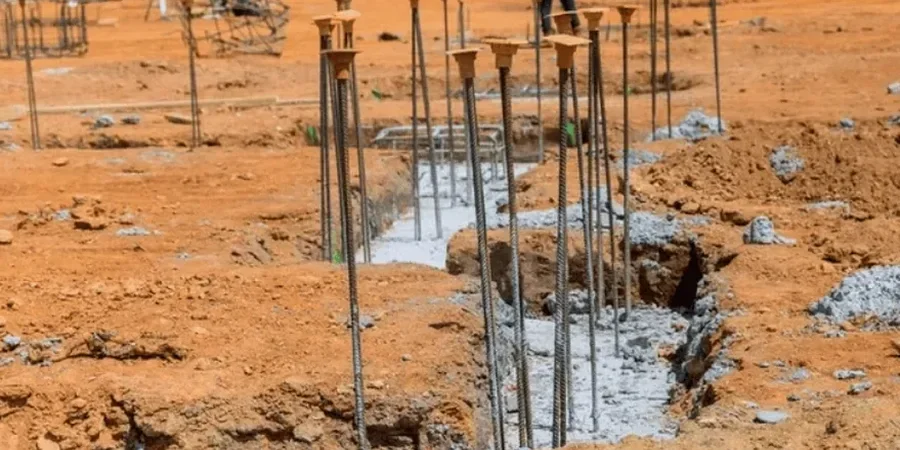
In Napier, you don't get far past the topsoil before you hit the stuff that makes every structural engineer pause—loose alluvial silts, layers of uncompacted sands, and groundwater that sits barely a metre down across the Heretaunga Plains. The 1931 earthquake taught us here that the ground isn't just a passive platform; it liquifies, it settles, and it shifts laterally in ways that shallow footings simply cannot handle. That's why pile foundation design in this city is rarely a straightforward exercise. We regularly combine borehole data from sondajes SPT with cone penetration testing to map the depth to competent bearing strata, which in areas like Taradale or Marewa can sit 12 to 18 metres below the surface. Getting that profile right from day one means the difference between a structure that rides out a seismic event and one that doesn't.
In Napier, the 1931 event rewrote the book on ground performance—pile design here isn't about bearing capacity alone, it's about surviving lateral spread and cyclic softening.
Process overview
The ground changes noticeably just moving from Ahuriri to Napier South. Around the port and Ahuriri, you're dealing with reclaimed estuary deposits—highly variable fills over marine silts that demand pile lengths often exceeding 15 metres. In contrast, moving up toward Hospital Hill, you encounter stiffer volcanic-derived soils where shorter driven piles or bored cast-in-place elements can be viable, though the sloping topography introduces lateral demands that can't be ignored. Across all these zones, our pile foundation design process integrates lab testing like
triaxial tests to determine drained and undrained shear strength parameters, directly feeding into the axial capacity calculations. We also account for down-drag forces in areas where the soft clays are still consolidating under recent alluvial deposition. The NZGS guidelines and NZS 3404 steel requirements shape every calculation, but it's the local ground truth—measured pore pressures, SPT N-values, and plasticity indices—that ultimately dictates the pile diameter, reinforcement, and embedment depth.
Local context
NZS 4203 and the newer performance-based seismic framework put Napier squarely in one of the most demanding design environments in the country. The risk isn't theoretical—it's documented in the 1931 ground ruptures, lateral spreading along the coast, and the deep liquefaction ejecta mapped across the plains. Skipping a site-specific pile foundation design here exposes a building to differential settlement that can exceed 100 mm between adjacent columns, which is catastrophic for structural integrity. The high water table compounds the problem by reducing effective stress during shaking, increasing the potential for bearing capacity loss under cyclic loading. We address this by designing piles to bypass the liquefiable layer entirely, socketing into competent gravels or the underlying Pliocene limestone, and checking for kinematic bending moments induced by lateral ground displacement. Without that analysis, even a correctly sized pile can shear at the interface between the liquefied and non-liquefied layer.
Questions and answers
How much does a pile foundation design cost for a typical residential project in Napier?
For a standard single-dwelling residential pile foundation design in Napier, including a site-specific geotechnical investigation, the total fee typically ranges from NZ$2,950 to NZ$9,700 depending on the number of piles, the depth of investigation required, and the complexity of the seismic analysis.
Why can't I just use shallow footings on the Heretaunga Plains?
Much of the plain consists of soft alluvial silts and loose sands that are prone to liquefaction and excessive settlement. Shallow footings in these conditions risk differential settlement and bearing failure, especially under seismic loads. Piles transfer the load to deeper, competent strata, bypassing the problematic upper layers.
What pile type is most common in Napier's coastal conditions?
Driven steel H-piles are widely used because they can be driven through soft, loose layers to reach competent gravels or rock. Bored cast-in-place piles are also common on sites with access constraints or where vibration must be minimised. The choice depends on the ground profile, load demands, and constructability constraints at each specific site.
How do you account for liquefaction in pile design?
We identify the liquefiable layers through SPT or CPT testing, then design the pile to effectively ignore the skin friction in those layers during a seismic event. The pile is socketed into a non-liquefiable bearing layer, and we check the pile section for bending moments induced by lateral spreading of the liquefied crust. This often requires a kinematic pile-soil interaction analysis.