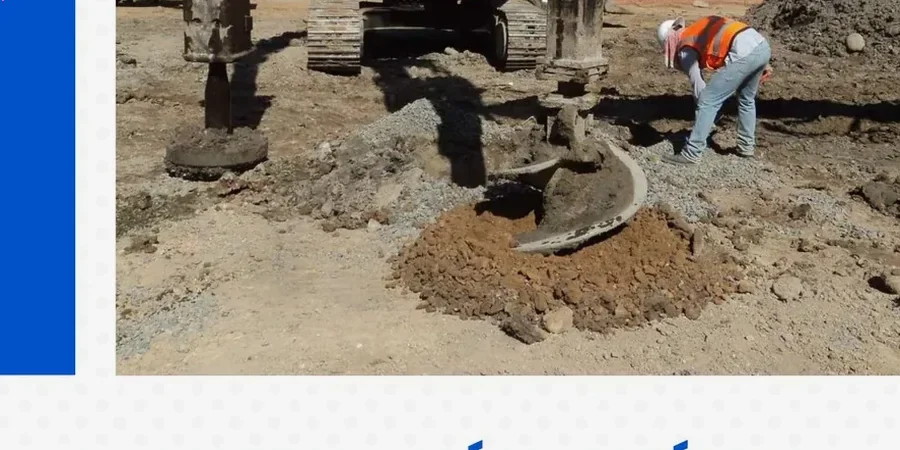
Napier sits on a coastal aquifer where silty sands and layers of marine sediment create a unique set of challenges for shallow foundations. The water table here is often barely two metres below the surface, which means loose deposits can densify poorly under load. In our experience across the Hawke's Bay region, stone column design becomes the most practical ground improvement method when you need to bypass those soft upper layers without deep piling. The 1931 earthquake reshaped this land, lifting the seabed by over two metres, and that legacy still influences how we approach bearing capacity today. A well-designed column array distributes structural loads past the problematic crust and into the more competent gravels below. For sites near the Ahuriri Estuary or the industrial flats, we often combine this approach with a CPT test to map the exact depth of the compressible layer before finalising the column grid.
A stone column array in Napier's silty sands does two jobs at once: it carries the structural load and drains the pore pressure that drives liquefaction.
Process overview
The rigs we mobilise around Napier are mid-sized vibroflots with a 130 kW power pack, small enough to access tight residential sections on the Bluff Hill slopes yet powerful enough to reach 8 to 10 metres into the sandy silt. A water-jetting system assists penetration through the dense crust that overlies the liquefiable layer in many parts of town. The stone itself matters. We source clean, angular greywacke aggregate from local quarries near the Esk Valley, graded between 25 and 75 mm. That angularity locks the columns against the surrounding soil, creating a composite mass that drains excess pore pressure during a seismic event. Each column is built in lifts of roughly 60 cm, backfilled from the bottom up, with the vibrator re-penetrating each lift to force lateral displacement. What we see on site is a rapid improvement in stiffness. The surrounding sand densifies, the column bulbs out slightly at depth, and the whole treatment zone acts like a reinforced block under the footing.
Local context
The Heretaunga Plains underlie most of Napier's urban area, a deep basin of alluvial gravels, sands, and silts that amplifies seismic shaking. The NZGS guidelines classify much of this ground as liquefaction Category B or C, meaning a moderate earthquake can trigger a sudden loss of soil strength. Without treatment, a raft or pad footing on these deposits can settle unevenly by 100 mm or more during a design-level event. The risk is not theoretical. The 1931 Hawke's Bay quake produced widespread lateral spreading along the old lagoon margins, and modern site investigations still find loose saturated layers at depths between 3 and 7 metres. Stone columns mitigate this by introducing stiff, draining inclusions that reduce the cyclic shear strain in the surrounding soil. They also create a preferential drainage path, so excess pore pressure dissipates in seconds rather than minutes. For critical structures near Marine Parade or the CBD, we model the post-treatment Factor of Safety against liquefaction using CPT-based triggering curves, ensuring the ground meets the performance criteria set out in the MBIE/NZGS guidance.
Questions and answers
What does stone column design cost for a typical Napier section?
For a standard residential or light commercial site in Napier, the design and verification package usually falls between NZ$2,330 and NZ$7,590 depending on the number of columns, the depth to competent ground, and the extent of CPT testing required. A simple grid for a single dwelling on a 600 m² section sits at the lower end, while a multi-column commercial layout with post-installation zone testing moves toward the upper end.
How do stone columns reduce liquefaction risk in Hawke's Bay?
They do two things at once. First, the vibratory installation densifies the sandy soil around each column, which increases its cyclic resistance. Second, the column itself acts as a high-permeability drain. During shaking, pore water pressure can bleed off through the stone column instead of building up in the soil, so the ground retains much more of its strength.
How deep do you typically install stone columns in Napier?
Most projects around the Heretaunga Plains require columns between six and twelve metres deep. We set the exact depth where the CPT tip resistance shows a competent bearing layer, often the dense gravels that underpin the region. Shallower columns around eight metres are common on the Taradale side, while the old lagoon and estuary margins can push past ten metres.
What verification testing do you perform after installation?
We always run a set of CPT soundings between columns to measure the improvement in tip resistance and sleeve friction. On larger jobs we add zone load tests, where a group of columns is loaded through a stiff platform to confirm the composite modulus. Settlement monitoring over the first year gives us the long-term performance picture.