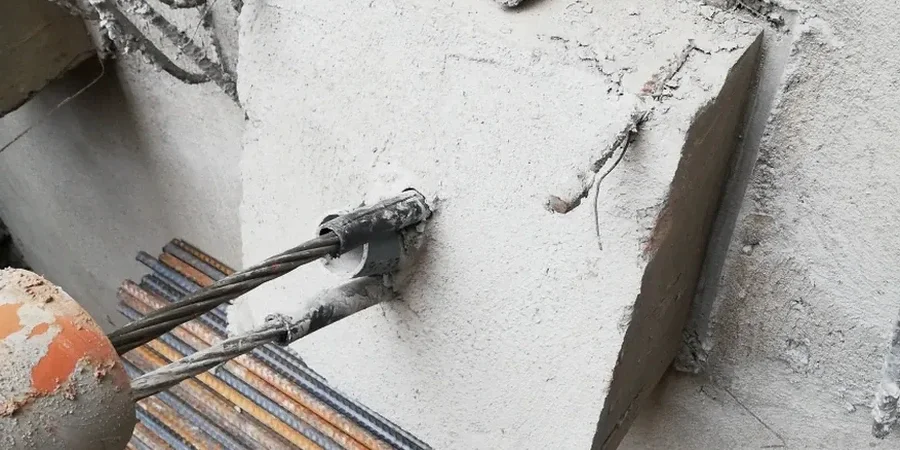
Anchor design in Napier operates within a strict regulatory framework shaped by NZS 3404 and NZGS guidelines, and nowhere is this more relevant than on the marine terraces that define the city's coastal margin. The interaction between Pleistocene limestone, interbedded gravels and overlying soft alluvium demands careful differentiation between active and passive anchor types, especially when temporary shoring transitions to permanent retention. In the Ahuriri and Bluff Hill areas, where cut slopes expose weathered calcareous sandstone, a slope stability assessment often triggers the need for pre-stressed ground anchors to control deformation before excavation reaches final depth. The design team evaluates bond length, free length, tendon type, corrosion protection class and lock-off load against the specific groundwater conditions and seismic demand that Napier's location on the Pacific Ring of Fire imposes on every permanent anchorage.
A properly designed active anchor is a predictable tension element; a poorly detailed one is a deferred liability that costs ten times more to remediate after excavation.
Local context
Napier's seismic environment — the 1931 earthquake raised the coastal plain by up to 2.7 metres — contrasts sharply with the subtropical humidity that accelerates corrosion in exposed anchor components. This dual threat means anchor design cannot default to inland North Island assumptions. Marine aerosol in the Bluff Hill and Westshore zones pushes corrosion protection to Class 2 or even Class 3 where permanent anchors are inaccessible for inspection. Simultaneously, the peak ground acceleration values used in the CBD, typically above 0.35 g, require the free length to extend well behind the seismically induced failure wedge. A detail that is frequently overlooked is the performance of the anchor head under cyclic loading: if the bearing plate sits on concrete with inadequate bursting reinforcement, progressive spalling can occur during a moderate event, releasing lock-off load precisely when the retaining structure needs it most. Careful detailing of the anchorage zone, including supplementary links and a minimum edge distance of 300 mm, is standard in our Napier designs.
Reference standards
NZS 3404: Steel Structures Standard — anchor design, corrosion protection and testing, NZS 4203: General Structural Design and Design Loadings for Buildings, NZGS guidelines — ground anchor design, installation and monitoring, AS/NZS 4671: Steel reinforcing materials — bar anchor compliance, PTI DC35.1 — Post-Tensioning Institute recommendations for rock and soil anchors
Questions and answers
What is the difference between active and passive anchors?
Active anchors are tensioned to a specified lock-off load after installation, applying a pre-compression to the retained ground or structure before any excavation-induced movement occurs. Passive anchors, by contrast, only develop resistance once the ground begins to deform and load the tendon. In Napier, active anchors are typically specified for permanent retaining walls and deep excavations where deformation control is critical, while passive rock bolts are common for temporary cut stabilization in the limestone and sandstone of Bluff Hill.
How does the NZS 3404 standard apply to anchor design?
NZS 3404 governs the structural design of steel components in ground anchors, including tendon selection, corrosion protection classification, anchorage zone detailing and testing procedures. For a permanent anchor in Napier's marine environment, the standard requires a minimum Class 2 double-corrosion protection, with Class 3 specified where post-construction access for inspection is not possible. The standard also defines proof test durations, lock-off tolerances and acceptance criteria that all anchor installations must satisfy before the excavation can proceed below anchor level.
What does active/passive anchor design cost in Napier?
Anchor design fees in Napier typically range from NZ$1,590 for a single-anchor verification design with load testing specification to NZ$7,110 for a full multi-row anchored wall package including seismic analysis, corrosion protection detailing, construction sequencing and on-site proof testing supervision. The final cost depends on the number of anchor rows, the complexity of the ground profile and the required corrosion protection class.
How long does anchor installation and testing take on a typical Napier project?
For a single row of 15 to 20 active anchors on a medium-depth excavation, installation and proof testing usually spans 8 to 12 working days. This includes drilling through the mixed gravel and limestone common in Napier, grouting, a curing period of 5 to 7 days depending on grout mix and ambient temperature, and the staged proof testing of each anchor. The programme is sequenced so that anchor stressing does not delay bulk excavation, with the first row of anchors typically ready for lock-off within two weeks of drilling.