← Home · Laboratory

Grain Size Analysis (Sieve + Hydrometer) for Hawke's Bay Soils

Together, we solve the challenges of tomorrow.

LEARN MORE →

The coastal plains around Napier sit on a complex mix of alluvial gravels, marine sands, and thick layers of silt carried down by the Tutaekuri River. You can't guess the drainage behavior or compaction potential of these soils just by looking at them. A proper grain size analysis tells you exactly what you're working with. Our lab processes samples from across the city weekly, and what we see most often are gap-graded gravels with a high silt fraction that completely changes the permeability story. When we run the full combined sieve and hydrometer test, we often find 15-20% fines that the naked eye missed. This is the kind of data that saves a retaining wall design from failure. For deeper investigations, we cross-reference results with data from an in-situ permeability test when the site conditions demand it.

A gap-graded gravel with 18% fines looks stable in the hand but drains like a silt, and that misread has caused more Hawke's Bay foundation problems than we care to count.

Methodology and scope

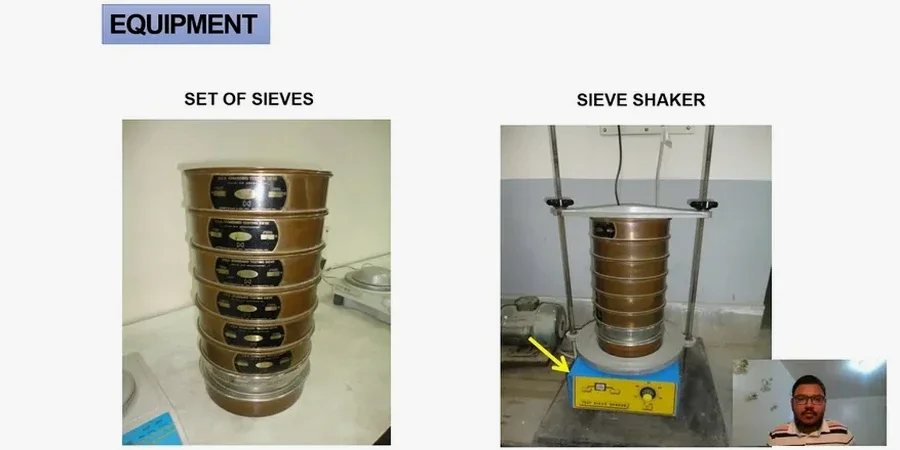
We see very different particle distributions depending on whether the sample comes from the older terraces near Hospital Hill or the younger floodplain near Marewa. The terrace soils tend to be well-graded with a decent gravel component, while the Marewa silts are remarkably uniform and problematic for drainage. Our grain size analysis quantifies that difference. We run the coarse fraction through a full stack of sieves per NZS 4402, then put the fines through the hydrometer using sodium hexametaphosphate as dispersant. The result is a continuous curve from 37.5 mm down to 2 microns. This is the foundation for classification under the NZGS system. When we find sensitive silts with a high clay fraction, the team often recommends following up with Atterberg limits to nail down the plasticity characteristics, and an SPT drilling program when the client needs N-values correlated with the gradation profile.
Grain Size Analysis (Sieve + Hydrometer) for Hawke's Bay Soils
Technical reference image — Napier

Local considerations

The climate here throws a real challenge at soil testing. Napier's Mediterranean-style dry summers followed by intense winter rain events mean that near-surface soils can test as gravelly sand one month and behave as erodible silt the next. A grain size analysis run on a poorly preserved sample gives you a curve that doesn't match the field behavior. We dry samples at 60°C maximum to avoid altering clay minerals, and we always note the field moisture condition on the report. Another risk is the presence of pumice sands in some coastal deposits around Westshore. These crush during compaction and shift the entire gradation curve. If the analysis doesn't account for particle crushing, the specification for filter material or drainage aggregate will be wrong from day one.

Need a geotechnical assessment?

Reply within 24h.

Email: [email protected]

Technical parameters

ParameterTypical value
Coarse sieve range75 mm down to 75 µm (No. 200)
Hydrometer range75 µm down to 2 µm (clay fraction)
Dispersing agentSodium hexametaphosphate (Calgon)
Test standard followedNZS 4402:1986, Test 6.1 to 6.5
Minimum sample mass150 g for fine soils, 5 kg for gravelly soils
Hydrometer typeASTM 152H, calibrated at 20°C
Reporting parametersD10, D30, D60, Cu, Cc, % gravel/sand/silt/clay
Typical turnaround3-5 working days

Associated technical services

01

Combined Sieve & Hydrometer

The complete test from 37.5 mm down to the clay fraction. We use mechanical shakers for coarse material and a controlled sedimentation bath for the hydrometer, giving you the full PSD curve for NZGS classification.

02

Wash Sieve Analysis

When you just need to quantify the fines content. We wash the sample over a 75 µm sieve, dry and weigh both fractions. Fast, practical, and often enough for granular fill acceptance.

03

Particle Crushing Assessment

A targeted analysis for pumiceous and crushable sands. We run gradation before and after a standard compactive effort to quantify the shift in D50, critical for drainage layer design in coastal Napier.

Applicable standards

NZS 4402:1986 Methods of testing soils for civil engineering purposes (Tests 6.1–6.5), NZGS Guideline for the Field Classification of Soils (current edition), NZTA M/6 Specification for granular filter materials, BS 1377-2:1990 (referenced where NZS methods are equivalent)

Questions and answers

What does a combined grain size analysis cost in Napier?

For a standard combined sieve and hydrometer test on a single sample, you can expect to pay between NZ$180 and NZ$330. The final number depends on whether we need to wash the sample first, the maximum particle size, and how many hydrometer readings are required to define the clay fraction accurately.

How long does the hydrometer part of the test take?

The sedimentation phase runs over a minimum of 24 hours, with readings taken at specific intervals: 0.5, 1, 2, 4, 8, 15, 30, 60, 120 minutes, and then again at 24 hours. Sample preparation and the sieve portion add another day, so the full combined test typically reports in 3 to 5 working days.

Can you test soils with a lot of pumice or volcanic material?

Yes, and this is common in Napier. We handle pumiceous soils carefully because the particles can break down during sieving. We run the coarse fraction with minimal mechanical agitation and always note on the report if crushing was observed. For critical drainage applications, we recommend a separate crushing assessment to see how the gradation shifts under compaction.

What classification system do you use for the results?

We report particle size distribution according to the NZGS field classification system, which splits soils into gravel, sand, silt, and clay fractions based on the 2 mm, 60 µm, and 2 µm boundaries. The report includes the coefficients of uniformity and curvature, plus the percentage in each fraction, so you can apply USCS or other systems if needed.
Location and service area

We serve projects in Napier and surrounding areas.

View larger map