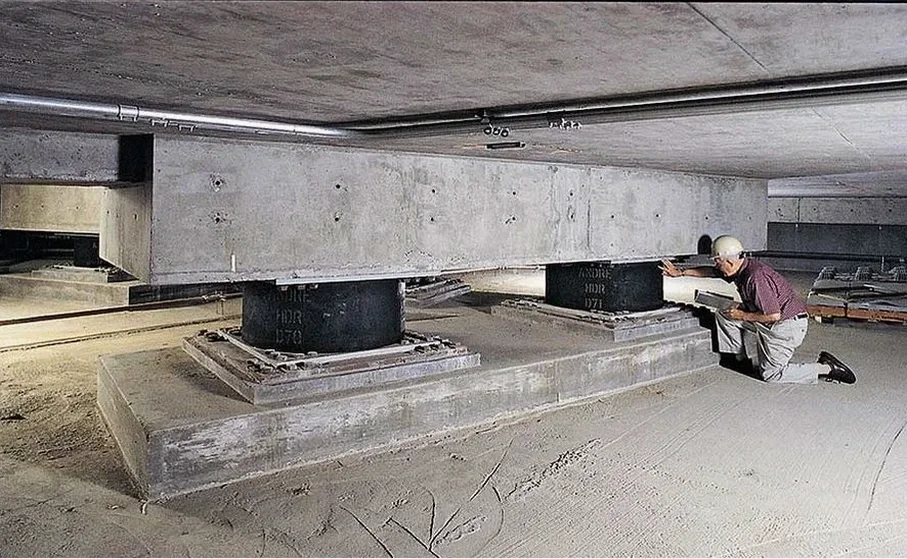
Napier sits squarely in one of New Zealand’s most seismically active regions, with the Hikurangi subduction zone capable of generating magnitude 8.0+ events less than 60 kilometres offshore. The 1931 quake reshaped the city and its geology, leaving a legacy of reclaimed land, estuarine silts, and variable alluvial gravels that demand more than conventional seismic design. Base isolation seismic design decouples a structure from ground motion, and in Napier’s soil profile—where soft layers amplify shaking—that decoupling becomes the difference between operational continuity and months of repair. We apply NZS 4203 loading provisions alongside NZGS site characterisation guidelines to size isolators for the specific spectral demands of the Hawke’s Bay coast. For deep soil sites where amplification is a concern, we cross-check the isolation period against the site’s fundamental frequency using data from our seismic microzonation surveys, ensuring the isolated structure does not drift into resonance with the ground.
In Napier, base isolation is not an upgrade—it is a rational response to a subduction zone that loads the city from two directions simultaneously.
Local context
Napier’s population of roughly 67,500 concentrates much of its economic activity within three kilometres of the coast, on ground that the 1931 earthquake raised by up to 2.7 metres in places. The same tectonic forces that lifted the seabed also make the region a textbook case for basin-edge effects: seismic waves entering the Hawke’s Bay sedimentary basin slow down and amplify, producing ground velocities that can double the shaking intensity expected on rock. A fixed-base building in this setting absorbs that energy through structural yielding—expensive to repair and dangerous for occupants. Base isolation seismic design redirects the energy into the isolation plane, where dampers convert it to heat and the building above moves largely as a rigid block. The risk of ignoring this approach in Napier is not just structural damage; it is the prolonged downtime that follows a moderate event, in a city where tourism and agribusiness depend on operational continuity within days, not years.
Questions and answers
How much does base isolation seismic design cost for a typical Napier building project?
For a medium-scale commercial or institutional building in Napier, the engineering design scope—including site-specific ground-motion studies, isolator sizing, non-linear time-history analysis, and a full design basis report—typically ranges from NZ$6,620 to NZ$12,100 depending on structural complexity and the number of ground-motion pairs analysed. Prototype testing supervision and construction-phase verification are priced separately based on the isolator count and laboratory location.
Is base isolation feasible on Napier’s soft reclaimed soils?
Yes, and it is often the preferred strategy. Soft soils amplify long-period motion, which a well-designed isolation system can detune from the superstructure. The key is extending the isolation period beyond 2.5 seconds and verifying that the isolators can accommodate the larger displacements that soft sites produce. We also assess liquefaction potential beneath the isolation raft and may recommend ground improvement such as stone columns or compaction grouting before isolator installation.
What regulations govern base isolation design in New Zealand?
Base isolation design falls under NZS 4203, NZS 3404, and the earthquake loading provisions of NZS 1170.5. The MBIE/NZGS seismic hazard modules provide additional guidance on site-specific response spectra, which are mandatory for Napier given the basin effects. All isolator prototypes must be tested to the acceptance criteria defined in the project-specific design basis report, and the testing programme is reviewed as part of the building consent process.
Can an existing building in Napier be retrofitted with base isolation?
Yes, though the engineering effort is greater than for new construction. We assess the existing foundation system, install temporary supports, and create a new isolation plane—often at ground floor or basement level. The superstructure must be stiff enough to behave as a rigid block above the isolators, which sometimes requires adding shear walls or bracing. The motion gap around the building perimeter is a critical detail in retrofits, especially on tight urban sites in central Napier where adjacent structures limit clearance.