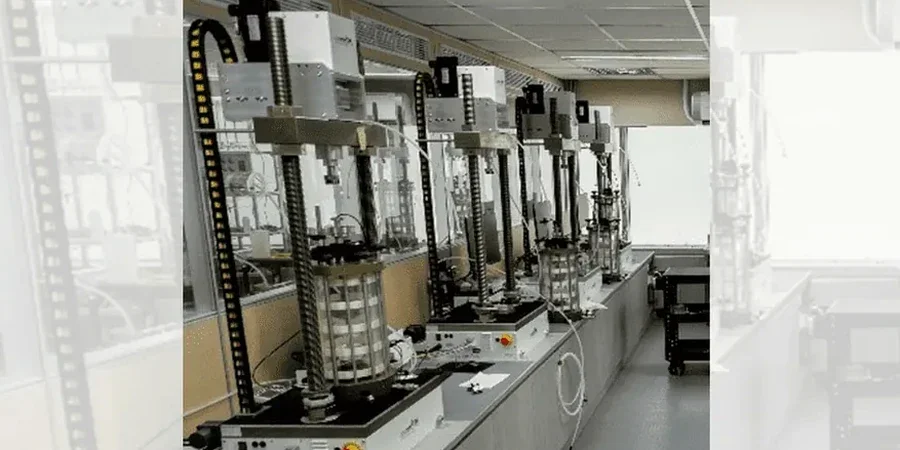
Napier’s rebuild after the 1931 earthquake literally reshaped the land, adding square kilometres of new ground to the Ahuriri spit. This legacy of uplifted seabed and art deco reinvention means we encounter a complex mix of estuarine silts, gravels, and man-made fill across the city. The 6.5-square-kilometre Ahuriri Lagoon catchment feeds into ground conditions that demand precision from the very first borehole log. When structural loads push into these layered deposits, standard penetration data only tells half the story. We rely on the triaxial test to simulate in-situ stress paths and extract the drained and undrained shear strength parameters that govern foundation design in Napier. Understanding whether a silty clay from Pandora will strain-harden or liquefy under seismic load is not academic here, it is the difference between a resilient structure and a vulnerable one. Complementing this with an in-situ permeability test clarifies drainage behaviour during consolidation.
A single triaxial test on saturated Napier silt provides both the undrained strength for seismic bearing capacity and the drained friction angle for long-term settlement, replacing three separate empirical correlations with one measured dataset.
Process overview
The most common error we see in Hawke’s Bay projects is specifying a single-stage unconsolidated undrained test and assuming the cohesion intercept holds true for long-term settlement analysis. An engineer might look at a stiff silt from a borehole near Taradale, note a high undrained shear strength, and skip the drained stage entirely. Six months later, a shallow footing shows differential movement because the effective stress parameters were never actually measured. To avoid this, we run consolidated undrained tests with pore pressure measurement as standard for clayey soils, then derive the Mohr–Coulomb envelope for both total and effective stress. For granular materials from the Esk Valley gravels, a consolidated drained test at low strain rates gives us the true friction angle without the ambiguity of excess pore pressure correction. The specimen is trimmed to a 50 mm diameter, saturated under back pressure until Skempton’s B parameter exceeds 0.95, and consolidated to stresses matching the proposed foundation depth plus surcharge. During shear at 0.01 to 0.1 mm per minute, the stress–strain curve reveals whether we are dealing with a brittle material that will peak and drop, or a ductile one that can redistribute load – a distinction that directly impacts the selection of bearing capacity factors from the NZGS guidelines.
Local context
Napier sits at just 2 metres above mean sea level across much of its urban core, with a population of 66,300 exposed to one of New Zealand’s highest seismic hazard zones. The Hikurangi subduction interface lies less than 50 kilometres beneath the city, capable of generating a magnitude 8.0+ event with strong vertical acceleration. When a triaxial test is skipped or reduced to a single specimen, the designer lacks the effective stress friction angle needed to evaluate post-cyclic strength loss in fine-grained soils. We have seen project delays stretch into months because the consent authority requested additional testing after reviewing incomplete geotechnical reports. The NZGS Module 4 guidelines explicitly require drained and undrained parameters for Class 2 structures in liquefiable terrain, which covers most commercial developments north of the railway line. Without measured triaxial data, the engineer defaults to conservative empirical correlations that can inflate foundation sizes by 30% or more, pushing budgets into unworkable territory. The real risk is not a catastrophic failure on day one, but a gradual loss of serviceability after a moderate earthquake, where permanent deformation accumulates in silts that were assumed to behave elastically based on SPT correlations alone.
Questions and answers
What does a triaxial test cost for a typical Napier residential or commercial project?
A standard consolidated undrained triaxial test on a single specimen runs between NZ$2,860 and NZ$4,980, depending on the number of confining pressures and whether pore pressure measurement is included. A full suite of three specimens with effective stress reporting is at the upper end of that range. We provide a firm quote after reviewing the borehole logs and confirming the soil type, because high-plasticity clays require slower strain rates and longer testing durations.
How many triaxial specimens are needed to define a Mohr–Coulomb failure envelope?
A minimum of three specimens, each consolidated to a different effective confining stress, is required to define a reliable failure envelope in p–q or Mohr–Coulomb space. For critical structures in Napier's seismic zone, we often run four specimens to confirm linearity and identify any curvature in the envelope at high stress levels, particularly in cemented gravels where the cohesion intercept may be stress-dependent.
Can triaxial testing be performed on gravelly soils from the Esk Valley or Ahuriri formations?
Yes, but specimen size must be scaled to the maximum particle diameter. For material containing particles up to 10 mm, a 50 mm diameter specimen is acceptable. Coarser gravels require 70 mm or even 100 mm diameter specimens to avoid boundary effects during shear. We trim the specimen carefully to preserve in-situ fabric, and for gravels with fines, we run a consolidated drained test at a strain rate slow enough to maintain drained conditions throughout pore volume.
How do triaxial results integrate with liquefaction assessments for Napier sites?
The undrained shear strength and effective stress friction angle from triaxial testing feed directly into post-liquefaction stability analyses prescribed by the MBIE/NZGS Module 1 guidelines. The cyclic resistance ratio from CPT or SPT data is combined with the drained friction angle to evaluate the factor of safety against flow sliding and lateral spreading. For silts that fall outside standard liquefaction triggering curves, the undrained strength from CU tests provides a direct input for residual strength assessment.