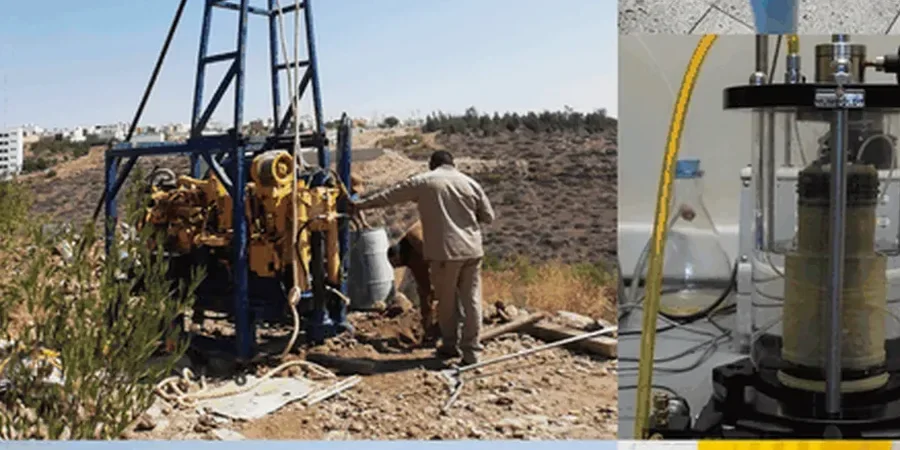
A three-storey apartment block on Marine Parade hit unexpected groundwater at two metres during excavation last winter. The contractor called us on a Thursday afternoon, concerned about base heave in the sandy silt. We had a technician on site the next morning, correlating field observations with lab data from undisturbed Shelby tube samples. Napier's coastal stratigraphy doesn't read textbooks. The alternating layers of fluvial gravels, estuarine clays, and post-1931 fill demand a soil mechanics study that goes beyond generic bore logs. Our laboratory runs consolidated-undrained triaxial tests alongside standard atterberg limits to build a constitutive model that actually reflects the stress history of the Ahuriri embayment. For deep foundations near the limestone escarpment, we pair that with a cpt test profile to catch loose pockets that rotary wash borings sometimes smear over.
Napier's post-1931 stratigraphy means every soil mechanics study here is a forensic exercise in depositional history, not just a parameter grab.
Local considerations
What we keep seeing across Napier subdivisions is a dangerous assumption: that SPT blow counts alone define liquefaction risk. The 1931 earthquake liquefied broad swaths of the old lagoon floor, and post-quake drainage hasn't eliminated the hazard. A proper soil mechanics study has to evaluate cyclic resistance from undisturbed samples, not just empirical correlations. We've pulled samples from Taradale sites where the fines content exceeded 35% yet the soil still triggered strain-softening under cyclic triaxial loading. That's a mechanism you'll miss if you skip laboratory phase. Add in the perched groundwater tables on Bluff Hill and the colluvial creep on the limestone slopes toward Havelock North, and the risk picture gets complex fast. The NZGS guidelines are clear: for Performance-Based Design in seismic areas, you need stress-strain parameters from multi-stage testing, not a single Mohr-Coulomb envelope from a textbook table.
Questions and answers
How much does a soil mechanics study cost for a residential section in Napier?
For a typical single-dwelling site on flat ground in Napier, Hawke's Bay, a soil mechanics study with a machine-dug test pit, sampling, and basic laboratory testing (grading, Atterberg limits, one triaxial set) runs between NZ$5,080 and NZ$8,760 plus GST. The range depends on access, depth to groundwater, and whether we need a drill rig instead of an excavator. Sites on Bluff Hill or near the marine parade with retaining wall requirements trend toward the upper end because of additional shear strength testing and slope stability analysis.
What laboratory tests are mandatory for liquefaction assessment under NZGS guidelines?
NZGS Module 4 requires either cyclic triaxial or cyclic simple shear testing on undisturbed samples for sites with moderate to high liquefaction susceptibility. You also need fines content, plasticity index, and particle size distribution to apply the Boulanger and Idriss (2014) triggering correlation. SPT and CPT data alone can screen low-risk sites, but if the fines content exceeds 15% and the soil plots in the moderately susceptible zone, laboratory cyclic testing becomes the only defensible path for a building consent application in Napier City Council jurisdiction.
How long does a full soil mechanics study take from sampling to final report?
Fieldwork is typically one to two days. Consolidation tests run three to ten days depending on the number of load increments and whether we need to measure secondary compression. Triaxial testing adds another week for a three-specimen set with pore pressure measurement. Including reporting, correlation, and peer review, most residential studies are complete in three to four weeks. Larger commercial projects with multi-stage triaxial and cyclic testing take six to eight weeks. We always sequence the critical-path tests first so preliminary foundation parameters are available for structural concept design within two weeks.